

 English


Complex Multi-Hole Milled Parts: Interconnected Geometry, Single-Datum Integrity
Suzhou Miaocheng Precision Machinery Co., Ltd. supplies these components as a Complex Multi-Hole Milled Parts manufacturer from our Suzhou factory in Wuzhong District, China. We are a custom precision CNC machining manufacturer and supplier, so every multi-hole part is planned from the customer's drawing, material requirement and application rather than from a standard catalog.
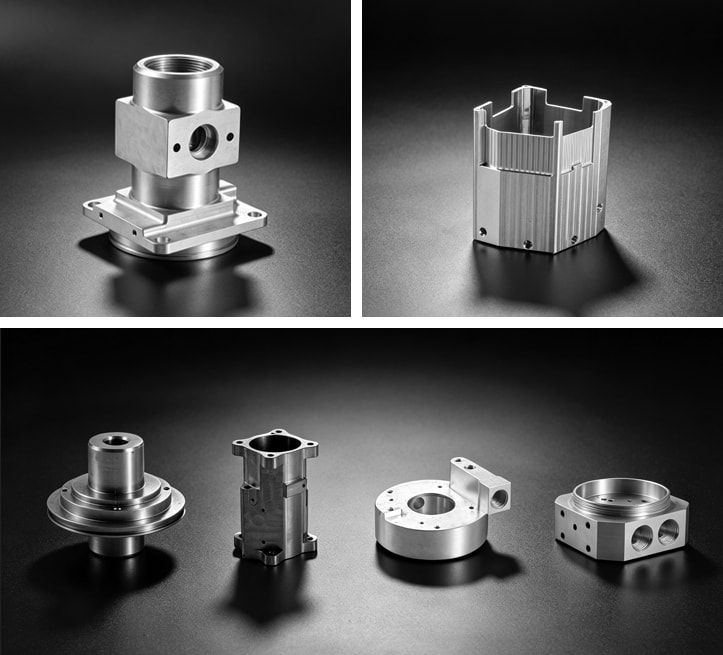
Complex multi-hole milled parts are components whose function depends on the relative position of many holes, bores, cavities and channels. Typical examples include valve bodies with cross-drilled passages, pneumatic control blocks with threaded ports, and structural parts with precisely positioned lightening holes.
What This Category Covers
This category belongs to the broader CNC Milling Parts family. What distinguishes it is the density of machined features and the relationships between them: holes on multiple faces, angled ports, intersecting channels, counterbores and tapped holes that must align to a common datum system.
- Cross-drilled and angled holes with controlled depths and intersections.
- Bored valve cavities, counterbores, spotfaces and seal recesses.
- Threaded holes, dowel holes and mounting-hole patterns on several faces.
- Milled slots, pockets and lightening features with thin-wall structural geometry.
Typical Parts and Application Fit
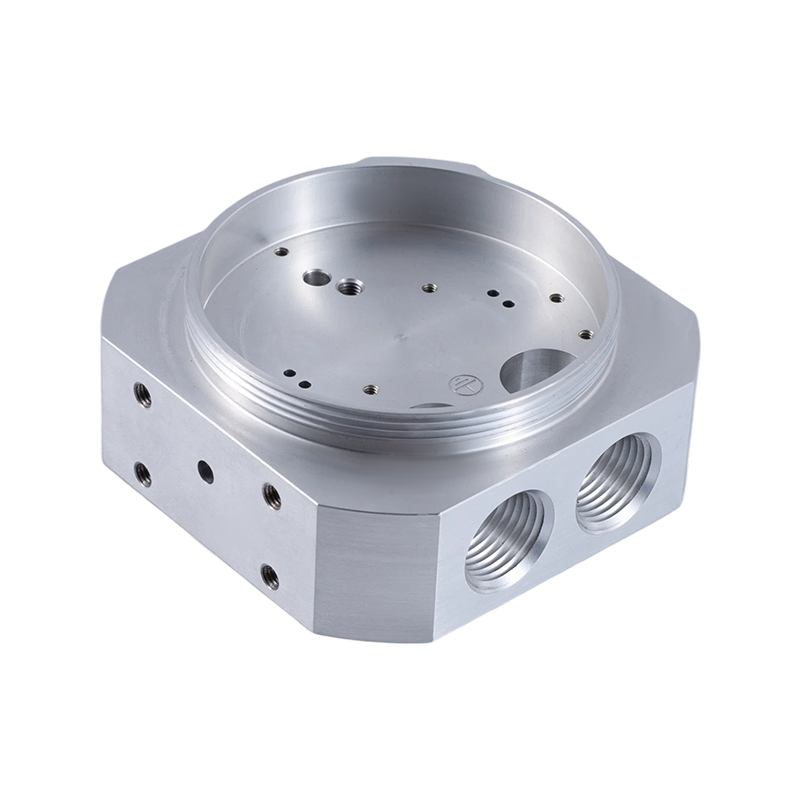
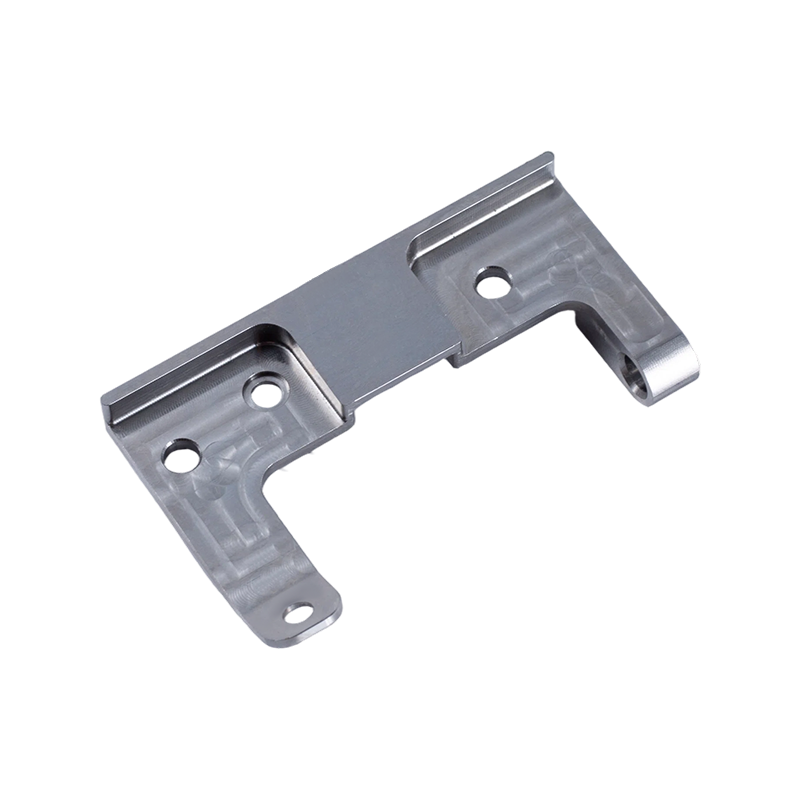
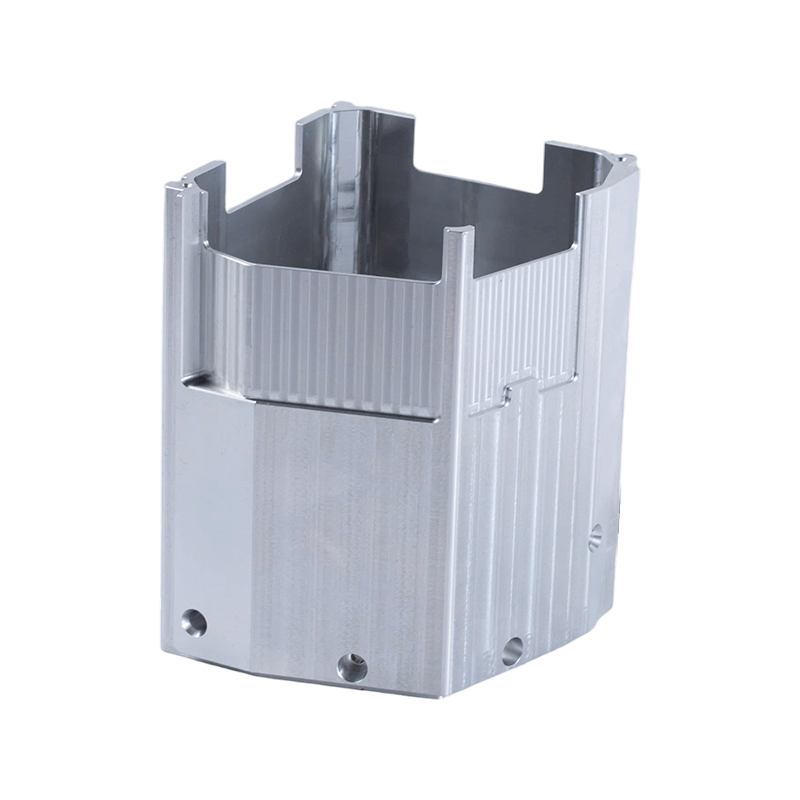
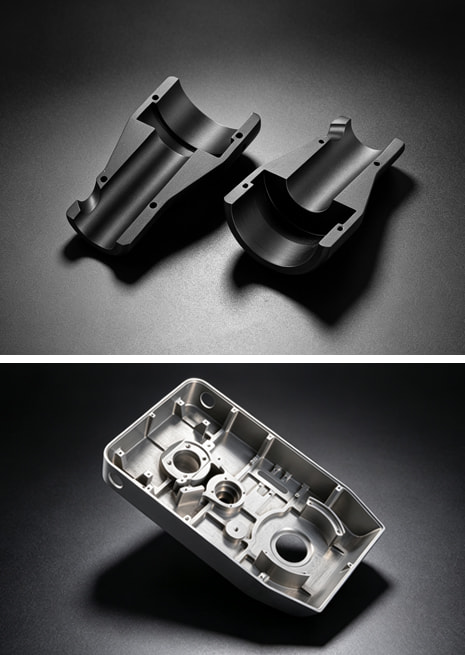
These components are found in fluid power, pneumatic control, powertrain, automation and aerospace assemblies. The product examples shown in this category include a precision fluid control component, a precision pneumatic control valve body, an aerospace-grade lightweight alloy structural component and an integrated multi-cavity structural component.
| Component type | Typical features | Main machining consideration |
|---|---|---|
| Valve and fluid-control bodies | Cross-drilled passages, threaded ports, valve cavities, seal faces | Port spacing and perpendicularity determine sealing and flow performance |
| Manifolds and distribution blocks | Interconnected channels, blind holes, pressed-in plugs | Burr control inside passages is essential for fluid integrity |
| Housings and enclosures | Counterbores, dowel holes, tapped holes, mounting faces | Datum relationship between holes and mating faces controls assembly |
| Structural and lightweight components | Thin walls, multiple lightening holes, close tolerances | Tool path and fixturing must prevent distortion in thin sections |
If a component is simpler and dominated by one large cavity or one mounting face, the Precision Housings & Enclosures category may be more fitting. When the same part combines multi-hole milling with coaxial turned diameters, we coordinate it with our CNC turning capacity.
Why Multi-Axis Milling Matters
Multi-hole parts reward careful process planning. The more features we can machine from one setup, the fewer positioning errors we introduce between datums and holes.
- 3-axis CNC centers are an efficient choice when critical features are concentrated on one side or parallel faces.
- 4-axis centers add controlled rotation around one axis, which suits holes distributed around a prismatic body.
- 5-axis centers allow angled holes, compound faces and cavity work in fewer operations.
Materials and Workpiece Considerations
Multi-hole milled parts are commonly produced from aluminum alloys, stainless steel, carbon steel, brass, copper and engineering plastics. The operating environment decides the material: corrosion resistance for fluid control, lightweight alloys for aerospace and automotive, and clean-machining metals for food and medical equipment.
- Aluminum alloys combine light weight, good thermal conductivity and high machining speed for structural and electronic parts.
- Stainless steel is preferred where sealing, corrosion resistance and clean surfaces are required.
- Brass and copper suit fluid, pneumatic and electrical applications.
- Engineering plastics are used when the part must be lightweight, insulating or low-friction.
Material grade, hardness and raw-material condition affect tooling, cutting parameters and inspection approach. We confirm these before finalizing the machining plan.
Accuracy, Inspection and Quality Assurance
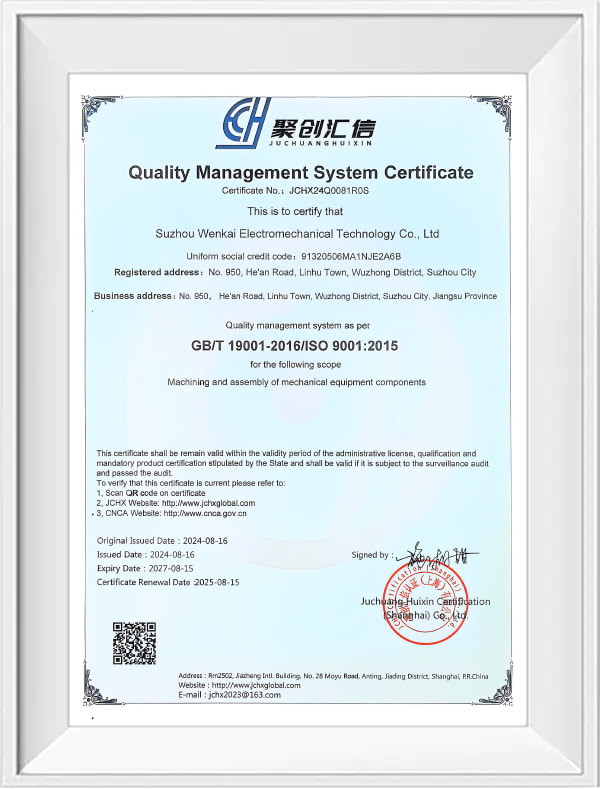
For complex multi-hole parts, the drawing usually controls hole position, perpendicularity, concentricity and thread quality more than individual diameter size. Our quality system follows ISO 9001:2015 and runs closed-loop from incoming material verification through in-process production to final outgoing inspection.
We measure with 3 CMM units plus precision height gauges and vision measuring machines. CMM verification is the most direct way to prove hole positions and bore relationships against the drawing datum system.
Prototype, Low-Volume and Production Support
Complex multi-hole parts are often validated in prototypes before serial release. Our Custom CNC Machining scope covers drawing-based production, sample-based production and small-batch prototype machining.
With a standardized plant of more than 2,000 square meters and a team of more than 50 employees, we can move from first-off prototype to production while keeping the same inspection discipline. Module assembly is also within our scope when the project requires assembled units rather than individual components.
Information We Use to Configure Your Solution
A precise quotation depends on the complete picture of feature relationships, not just the biggest outside dimension. Useful information includes:
- 2D drawing with dimensions, tolerances, datums, thread callouts and surface-finish requirements.
- 3D model in STEP or a compatible format for cavity, channel and complex hole geometry.
- Material grade and raw-material size or condition.
- Target quantity and project phase: prototype, small batch or serial production.
- Inspection requirements such as CMM report, full layout inspection or in-process records.
- Surface treatment, coating, marking or assembly to be included in the scope.
Frequently Asked Questions
Which parts belong in Complex Multi-Hole Milled Parts?
Components with several functionally linked holes, bores, channels or cavities on more than one face. Typical examples are valve bodies, manifold blocks, pneumatic control bodies and structural parts with complex hole patterns.
What drawing information has the strongest influence on cost and feasibility?
Datum references, hole position tolerances, depths, thread callouts, perpendicularity and concentricity are the most important. Surface finish, edge-break requirements and material grade also affect the machining strategy.
Can you manufacture from an existing sample?
Yes. In addition to drawing-based production, our custom machining scope accepts sample-based projects when a drawing is not available.
How do you verify hole positions on multi-hole parts?
We use CMM measurement plus precision height gauges and vision measuring machines, supported by closed-loop quality control from incoming material to final outgoing inspection.
Do you support both prototype and production volumes?
Yes. The same process and inspection discipline can be applied to prototype, small-batch and serial production, depending on the project plan.



